
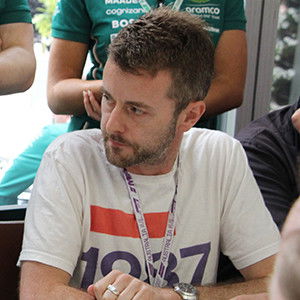


The presenter, who has covered more than 200 Grands Prix across a 14-year career, came under increased scrutiny during the 2025 season following a series of raw post-session interviews.
They included Lewis Hamilton’s visibly frustrated exchanges after difficult Ferrari outings and Max Verstappen’s heated response following his Spanish Grand Prix clash with George Russell.
One of the most discussed moments came in Hungary, when Hamilton described himself as “useless” during a difficult media pen appearance after a Q2 exit.
Earlier in the season in Spain, he also apologised to Brookes off-camera after giving one-word answers following another disappointing result for Ferrari.
Brookes said moments like those are part of what makes the role both demanding and important.
“I’m still a fan as well. That’s the big thing. I’m a fan of the racing. I’m a fan of the sport,” she told Speedcafe.
Take the short survey.
“I mean there are times where Lewis has given me one word answers, and instead of pushing him I just let him go.
“Because you’re not going to get anything good out of somebody in that mood.
“You’re not going to get them to suddenly say something groundbreaking. You are just going to really hack them off.
“So if you want those relationships, you’ve got to be able to understand the mood they’re in at the time.
“But also, at the same time, if somebody’s done something wrong, you have to call them out, because the whole world’s been watching.
“So you’re not calling them out to have a go at them, you’re calling them out so that hopefully they will answer it and give the fans a reason.
“And you’re giving them a right of reply.”
Brookes herself was subjected to online abuse following her exchange with Verstappen in Spain, where she asked the Dutchman directly whether he had deliberately driven into Russell in the closing stages of the race.
“Max in Spain last year with George was the biggest one. Both sides,” she explained.
“He got a lot of criticism for what he did. I got criticism for asking him if it was deliberate.
“But that’s the question people were asking watching the TV. Did he do that on purpose?
“So I have to let him say, no, absolutely not. I had an issue in the car, or I had this, or I had that.
“Because we don’t know. Unless you ask him, you don’t know.
“It’s since come out obviously that he’s said, yeah, I was wrong and whatever.
“But at the time in that moment it’s my job to ask him if he did it on purpose. I can’t shy away from that.”
She also pointed to the immediacy of F1 media duties as something unique to the sport, with drivers often speaking publicly within minutes of climbing out of the car.
“They get put in front of the world’s media immediately,” she explained.
“And I just think that sometimes you have to try and put yourself in their shoes and think this is horrible for them right now.”

Brookes said that balance between emotion, accountability and explanation also fed into her broader work on the sport, including her new book, F1 Racing: Drive.
Rather than focusing on paddock controversy, the book explores the technical, psychological and human elements that can create major performance differences between teammates driving identical machinery.
Brookes said the subject became increasingly fascinating during years of interviewing drivers across the grid.
“I wanted to understand properly why one driver can put a car on pole and another driver goes out in Q1. Same car. Teammates. All the same data. All the same information,” she said.
“And yet, from the 20 best drivers in the world there can be such a huge difference.”
The book revisits a number of key moments from Brookes’ time in the paddock and also draws on interviews with current and former F1 personnel, including past and present drivers.
Oscar Piastri was among those interviewed, with Brookes highlighting his calm and analytical approach while discussing performance, rivals and Formula 1 greatness, naming drivers such as Hamilton, Michael Schumacher and Ayrton Senna among the greatest drivers.
“I think it’s really hard to ask a current driver their greatest of all time, because they always want to be the greatest, right?” she said.
“That’s why they’re there. That’s why they’re still doing it.
“So I think it’s really hard. But I am always fascinated by who’s influenced them in their career.
“When they mention the names from different eras, I’m interested in who they actually look up to as a driver.”
Brookes added that the original idea for the book came from wanting to better understand what ultimately separates drivers at the very highest level, even when they have access to the same engineers, information and equipment.
She said she hoped the final product would appeal both to long-time F1 followers and newer audiences drawn into the sport in recent years.
“My friend said they were worried it would be too technical for them… but they said they really enjoyed it because of the way it was written,” she said.
Despite balancing the project alongside her role with Sky Sports and the scrutiny that can come with interviewing drivers in emotionally charged moments, Brookes said her passion for F1 remains unchanged.
“I love it,” she said.
“There’s a mutual respect I feel, and I hope that’s the case that they know I have a job to do.
“And I also never, ever want an interview to end on a bad note.”
Published by Michael O’Mara Books, F1 Racing: Drive is available now.






















Discussion about this post